
FoIKS 2026 Conference Program
The program of the conference can be found here and the proceedings can be found here.
The conference dinner will take place on Wednesday at 18:00 at the Gartensaal at Platz d. Menschenrechte 2, 30159 Hannover.
Accepted Long Papers
- Iosif Apostolakis and Johannes P. Wallner - Simplifying Argumentation Frameworks by Clustering Structural Patterns
- Franz Baader - An Order-Theoretic View on Optimal Repairs and Complete Sets of Unifiers
- Michael Baier and Johannes P. Wallner - Utilizing Binary Decision Diagrams for Compiling Argumentation Frameworks
- Leopoldo Bertossi and Felipe Azua - Causality-Based Scores Alignment in Explainable Data Management
- Nadia Creignou, Timo Merkl, Reinhard Pichler and Daniel Unterberger - From FPT Decision to FPT Enumeration
- Miika Hannula, Minna Hirvonen, Juha Kontinen and Sebastian Link - Independence Under Incomplete Information
- Jelle Hellings and Yuchen You - Short and Simple Explanations for Datalog Derivations
- Minna Hirvonen - Implication Problems over Positive Semirings
- Prosenjit Howlader and Churn-Jung Liau - A Modal Logic for Possibilistic Reasoning with Fuzzy Formal Contexts
- Tim Wolfgang Helmut Schwabe and Lena Wiese - Extending Similarity Measures for Incomplete Database Instances with Locality-Sensitive Hashing
- Lars-Phillip Spiegel, Christoph Beierle, Gabriele Kern-Isberner and Alexander Hahn - Conditional Constraint and Solution Splittings of Belief Bases in the Context of c-Representations
- Jan Van den Bussche and Emmanuel Waller - Analyzing the behavior of database applications through size descriptions
- Hongkai Yin - Revisiting the fluted and forward fragments with guards
Accepted Short Papers
- Aleksi Anttila, Juha Kontinen and Fan Yang - Complexity Results in Team Semantics: Nonemptiness Is Not So Complex
- Fausto Barbero - Two strong undefinability results
- Moritz Bayerkuhnlein, Özgür Lütfü Özcep and Diedrich Wolter - Abductive Expansion for Belief Bases
- Andreas Krebs and Arne Meier - When Symmetry Yields NP-Hardness: Affine ML-SAT on S5 Frames
- Sebastian Rudolph and Kai Sauerwald - Mutual Irreducibility of Revision and Multiple Revision
Accepted Poster Papers
- Andreas Brännström, Esteban Guerrero, Maria Wojtowicz, Jonna Hasselaar, Staffan Jacobson, Urban Wiklund and Juan Carlos Nieves - Towards Neuro-Symbolic Classification of Abrasive Wear in Scanning Electron Microscopy
- Mattias Brännström, Themis Dimitra Xanthopoulou and Andreas Brännström - Intermediate Knowledge Problem
- Matilda Häggblom - Axiomatizing variants of approximate inclusion
- Yudai Kubono - On Translating Epistemic Operators in a Logic of Awareness
- Zhengyang Lu, Paul Sarnighausen-Cahn, Jiahao Chen, Arie Gurfinkel, Florin Manea and Vijay Ganesh - SMT Algorithm Selection with High-Level Natural-Language Descriptions
- Jakob Suchan, Salim Baloch and Mehul Bhatt - Towards a VLM-based Foundation for Generalised Neurosymbolic Visual Commonsense
- Diedrich Wolter and Tobias Schwartz - Planning and Temporal Planning by Qualitative Temporal Reasoning
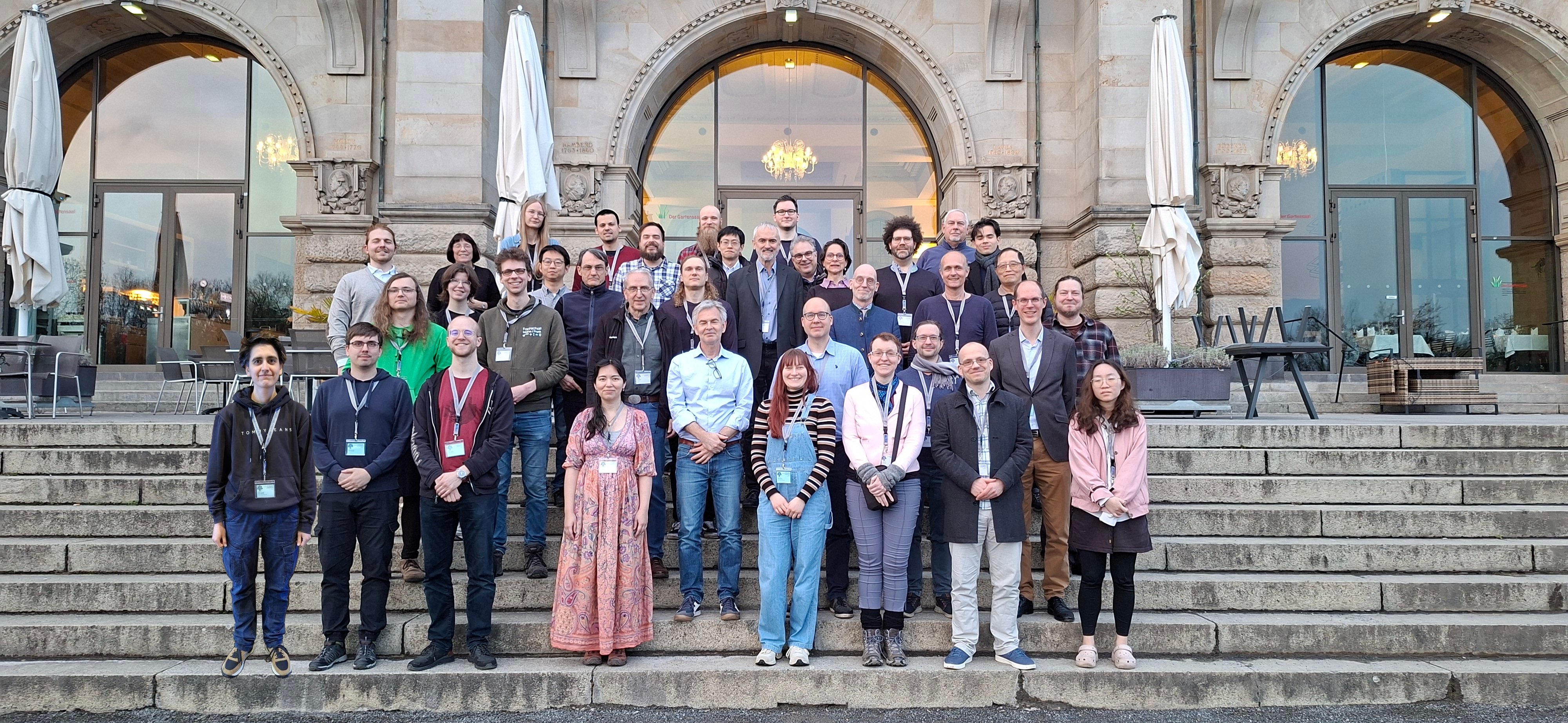
Conference Picture
Invited Speakers

Reactive (Program) Synthesis is an area of Formal Methods that studies how to automatically synthesize interactive programs (reactive systems) from a human-readable specification, typically expressed in temporal logic. In this talk, we will discuss its use in Autonomous AI Systems to equip them with strategic reasoning capabilities, as well as frame such capabilities within formally specified bounds that provide guardrails for their self-deliberated behavior. We will show that Reactive Synthesis is related to certain forms of AI Planning in partially controllable environments and to MDP solving. Technically, we will focus on specifications expressed in Linear Temporal Logic (LTL) and, in particular, its finite-trace variants such as LTLf. A key advantage of these finite-trace variants is their simplicity, due to their reducibility to equivalent regular automata, which can be easily determinized and transformed into two-player games on graphs. This simplicity leads to an unprecedented computational effectiveness and scalability of synthesis in LTLf compared to LTL. Finally, we will also show how to lift this finite-trace "technology" to infinite traces by leveraging Manna and Pnueli’s safety-progress hierarchy for temporal properties, which is ultimately based on a finite-trace core.
Giuseppe De Giacomo is a Professor of Computer Science in the Department of Computer Science at the University of Oxford. He has previously been a Professor at the Department of Computer, Control, and Management Engineering of the University of Rome "La Sapienza". His research spans theoretical, methodological, and practical aspects of Artificial Intelligence and Computer Science, with major contributions in Knowledge Representation, Reasoning about Actions, Generalized Planning, Autonomous Agents, Reactive Synthesis and Verification, Service Composition, Business Process Modeling, and Data Management and Integration.
He is a Fellow of AAAI, ACM, and EurAI. He received an ERC Advanced Grant for the project WhiteMech: White-box Self Programming Mechanisms. He has served as Program Chair of ECAI 2020 and KR 2014. He is a member of the Board of EurAI and chairs the steering committee of EurAI’s annual summer school ESSAI.

Relational data capture rich, structured dependencies that traditional learning methods struggle to exploit. Relational neural networks aim to model such data by integrating the relational reasoning principles underlying graph neural networks and graph transformers. This talk explores the theoretical foundations of these models and how their learning behaviour interacts with data heterogeneity, temporal dynamics, and schema structure. We question how to characterise what relational architectures can represent and how they learn. Finally, we outline prospects for principled foundation models that unify representation, reasoning, and transfer across diverse relational domains.
Floris Geerts is professor at the University of Antwerp, Belgium. Previously, he was a senior research fellow at the University of Edinburgh and a postdoctoral researcher at the University of Helsinki. He received his PhD in 2001 from the University of Hasselt, Belgium. His research interests include the theory and practice of databases, the study of data quality, the interaction between linear algebra, relational databases and graph neural networks. He has written a book on data quality and published over 130 technical papers.
His awards include three best paper awards, the PODS Alberto O. Mendelzon Test-of-Time award, an ACM SIGMOD Research Highlight Award and an ICLR outstanding paper award. He is an ACM Distinguished Member, was program chair of PODS and ICDT, the general chair of EDBT/ICDT and is currently the general chair of PODS. He served on the editorial boards of ACM TODS and IEEE TKDE, and was editor of various proceedings and special journal issues in the area of databases.

Reasoning is fundamental to the foundations of information and knowledge systems, enabling these systems to derive reliable conclusions from complex data. Research in FoIKS focuses on the development of logical, non-monotonic, and probabilistic reasoning methods for addressing uncertainty and incomplete information—capabilities that are essential for intelligent agents and robust knowledge-based systems. Effective reasoning empowers information systems to adapt, update, and validate knowledge as new data becomes available.
For LLM-based agents, reasoning is indispensable, as it facilitates planning, decision-making, problem-solving, and adaptation to dynamic environments in a manner that is both human-like and interpretable. Robust reasoning enables these agents to operate autonomously, tackle complex tasks through reflection, and provide justifications for their actions. These abilities are critical for tasks that require multi-step logic, effective tool use, and proficient interaction with humans or other agents.
This talk will examine whether these two perspectives on reasoning share common ground, highlighting recent research in LLM-related reasoning and discussing realistic expectations for future developments.
Professor Dr. Wolfgang Nejdl has been a computer science professor at Leibniz Universität Hannover since 1995, following roles at RWTH Aachen University and Vienna University of Technology. He has held visiting positions at leading institutions including Xerox PARC, Stanford, and EPFL Lausanne. Professor Nejdl directs the L3S Research Center and Data Science Institute at Leibniz Universität, with research spanning information retrieval, AI, the web, digital libraries, and tech-enhanced learning. He led the ERC Advanced Grant ALEXANDRIA and is involved in projects such as NoBIAS, Cleopatra, KnowGraphs, SoBigData++, and DAISEC, focusing on AI and cybersecurity. Active in the Leibniz AI Academy and Digital Education Initiative, he currently leads the Center for Artificial Intelligence and Causal Methods in Medicine. He has published over 470 scientific papers and holds an h-index of 80.

Ontology-based data access (OBDA) is a popular paradigm for data integration. In this paradigm, multiple data sources are integrated through mappings to an ontology. These data sources can be heterogeneous (databases, language models, knowledge graph embedding models, etc) and the information retrieved from them may have different levels of trust. So, when answering queries, one may well be interested in not only obtaining the answers but also knowing why/how these answers were obtained. Provenance here refers to the origin of a query result, in particular, which tuples in a database or which data sources were relevant for answering a query. This corresponds to a notion of explanation explored in the context of databases using commutative semirings. In this talk, I will present work on semiring provenance in the context of ontology-based data access. The focus will be on ontologies expressed in DL-Lite and solutions to determine the provenance of a query within the OBDA setting.
Ana Ozaki works as an associate professor at the University of Oslo. Her research focuses on knowledge representation and machine learning theory. She is particularly interested in algorithms for learning logical theories formulated in description logic and related formalisms for knowledge representation.
Ozaki has recently worked as Program Committee Chair for the 7th International Joint Conference on Rules and Reasoning and the 36th International Description Logic Workshop. Ozaki works as the principal investigator of the project Learning Description Logic Ontologies, funded by the Research Council of Norway. She is one of the principal investigators of the Norwegian Centre for Knowledge-driven Machine Learning.